International Telegraph Alphabet No. 2
How five holes in a strip of paper tape could carry letters, digits and signs: notes on the International Telegraph Alphabet No. 2.
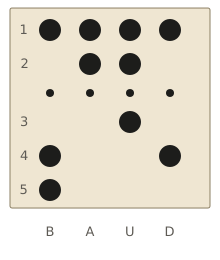
In brief
The alphabet works with only thirty-two five-element patterns. Two of them, LTRS and FIGS, switch between a letter case and a figure case, which is how one small code covers the alphabet, the digits and the common punctuation. The code descends from Émile Baudot’s telegraph code of the 1870s and Donald Murray’s keyboard version of 1901; the International Telecommunication Union maintains it as Recommendation S.1.
Quick facts
| Units per character | 5 (plus start and stop elements on a line) |
|---|---|
| Combinations | 32, read in letter case or figure case |
| Printable characters | 26 letters, 10 digits, 11 signs, plus 3 positions left for national use |
| Shift signals | LTRS (combination 29), FIGS (combination 30) |
| Standard | ITU-T Recommendation S.1 (current text 1988) |
| Successor | International Alphabet No. 5, the international form of ASCII |
More
- The full code table, with the hole pattern of every combination.
- Related topics: start-stop transmission, telex, radioteletype and paper tape.