Related topics
Short notes on the ideas and machines that grew up around the five-unit code.
Start-stop transmission
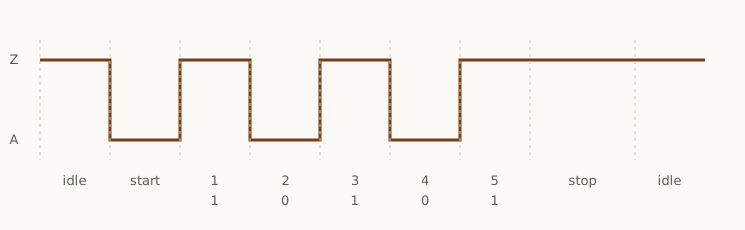
The receiver only measures time from the start element to the end of the character, so a slightly fast or slow clock is corrected at every new character.
Paper tape
Five-track tape let operators prepare a message offline and send it at full line speed. It could be copied, stored and fed back into a transmitter, an early form of store-and-forward messaging.
Radioteletype
On radio the two conditions are sent as two nearby frequencies. Amateur radio operators still use ITA2 this way, most often at 45.45 baud with a 170 Hz shift.
From ITA2 to ASCII
Seven-bit codes removed the need for shift signals and added lower-case letters, but kept carriage return and line feed, which still end lines of text today.